Cybersecurity Interview Questions and Answers can make or break your job opportunity. And yes — they can feel intimidating.
If you’re preparing for a security analyst, SOC analyst, ethical hacker, or even a fresher-level cybersecurity role, you don’t just need definitions. You need clarity, real-world context, and answers that make interviewers think: “This candidate understands security.”
So instead of dumping textbook theory, this guide gives you:
- ✅ Real-world-ready Cybersecurity Interview Questions and Answers
- ✅ Practical explanations (not robotic definitions)
- ✅ Cybersecurity Fresher Interview Questions explained simply
- ✅ Industry insights hiring managers actually care about
- ✅ Tips to structure your responses confidently
Let’s get straight into it.
🔑 Key Highlights
- 25 most asked Cybersecurity Interview Questions and Answers
- Includes both fresher and experienced-level questions
- Real-world examples you can use in interviews
- Updated with 2025 industry relevance
- Based on trends from ISC², CompTIA, and industry hiring patterns
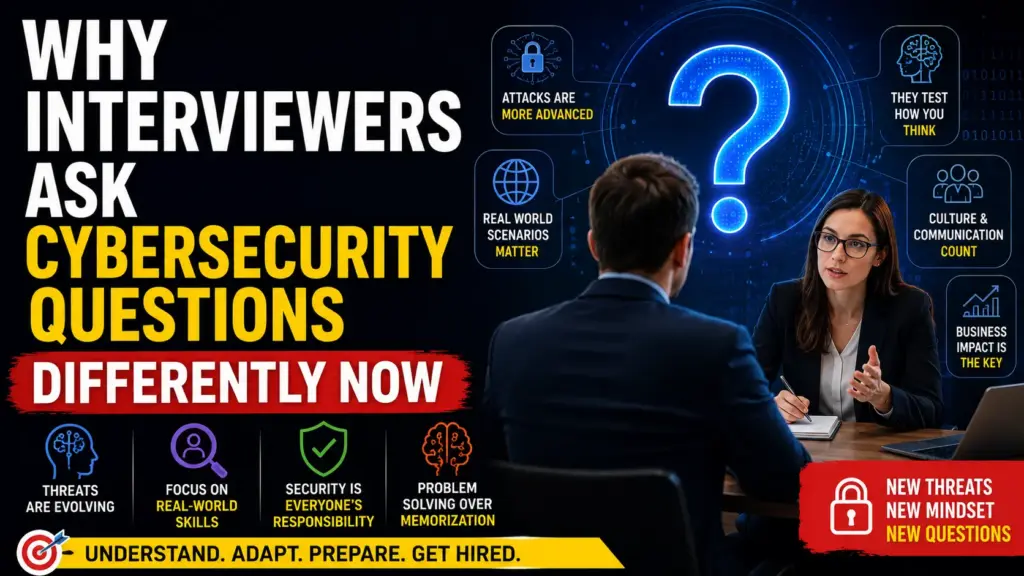
Why Interviewers Ask Cybersecurity Questions Differently Now
Cybersecurity jobs are growing fast.
According to the U.S. Bureau of Labor Statistics, information security analyst jobs are projected to grow 32% from 2022 to 2032 — much faster than average.
But here’s the catch:
Companies don’t just want someone who memorized definitions.
They want someone who:
- Thinks like an attacker
- Understands risk
- Knows how tools behave in real life
- Communicates clearly under pressure
That’s exactly what this article prepares you for.
🔐 Cybersecurity Interview Questions and Answers (Core Concepts)
1️⃣ What is Cybersecurity?
Answer:
Cybersecurity is the practice of protecting systems, networks, and data from digital attacks, unauthorized access, and damage.
But don’t stop there in an interview.
Add this:
“Cybersecurity focuses on maintaining confidentiality, integrity, and availability — the CIA triad — while minimizing business risk.”
That business angle makes you sound mature.
2️⃣ What is the CIA Triad?
This is one of the most common Cybersecurity Fresher Interview Questions.
- Confidentiality – Prevent unauthorized access
- Integrity – Prevent unauthorized modification
- Availability – Ensure systems are accessible when needed
Real-world example:
- Ransomware attacks (like WannaCry) break availability
- Data breaches impact confidentiality
- Database tampering affects integrity
3️⃣ What is a Firewall?
A firewall monitors and controls incoming and outgoing network traffic based on predefined rules.
But interviewers may ask:
“What’s the difference between a stateful and stateless firewall?”
Answer:
- Stateless checks packets individually
- Stateful tracks session states (more secure)
In real companies, stateful firewalls are standard.
4️⃣ What is a VPN?
A Virtual Private Network encrypts traffic between a user and a remote network.
Use case:
- Remote employees accessing internal systems securely.
Mention:
“VPN ensures confidentiality over public networks.”
5️⃣ What is Phishing?
Phishing is a social engineering attack where attackers trick users into revealing sensitive information.
Real-world stat:
According to Verizon’s 2023 Data Breach Investigations Report, 74% of breaches involve the human element, including phishing.
That number impresses interviewers.
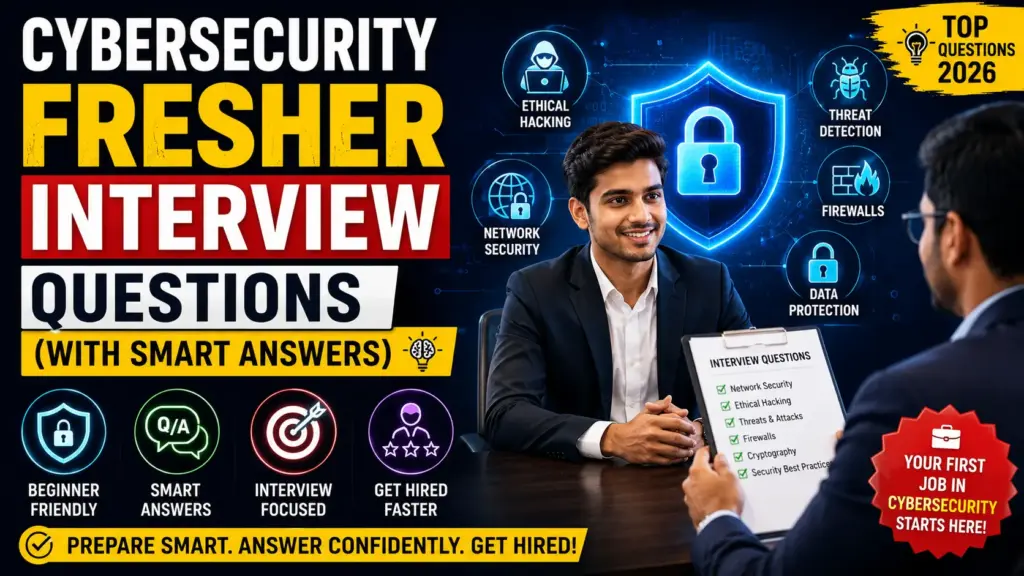
🧑💻 Cybersecurity Fresher Interview Questions (With Smart Answers)
If you’re just starting, you probably worry:
“What if I don’t have experience?”
Relax. Freshers are evaluated on fundamentals + mindset.
6️⃣ What is Malware?
Malware is malicious software designed to damage, disrupt, or gain unauthorized access.
Types:
- Virus
- Worm
- Trojan
- Ransomware
- Spyware
Pro Tip:
Explain one type in detail instead of listing blindly.
7️⃣ What is the Difference Between Vulnerability and Threat?
This question filters serious candidates.
- Vulnerability = weakness (e.g., outdated software)
- Threat = potential danger exploiting that weakness
- Risk = likelihood × impact
That formula shows analytical thinking.
8️⃣ What is SQL Injection?
SQL injection occurs when attackers insert malicious SQL queries into input fields.
Example:
Login form bypass using ' OR '1'='1
Mention:
- Input validation
- Prepared statements
- Parameterized queries
Developers respect that answer.
9️⃣ What is XSS (Cross-Site Scripting)?
XSS allows attackers to inject malicious scripts into web pages viewed by users.
Types:
- Stored
- Reflected
- DOM-based
Real example:
Stealing session cookies via injected JavaScript.
🔟 What is Encryption?
Encryption converts readable data (plaintext) into unreadable format (ciphertext).
Explain types:
- Symmetric (AES)
- Asymmetric (RSA)
Bonus:
AES-256 is widely used in enterprise systems.
🛡️ Intermediate-Level Cybersecurity Interview Questions and Answers
11️⃣ What is IDS vs IPS?
- IDS (Intrusion Detection System) – Detects and alerts
- IPS (Intrusion Prevention System) – Detects and blocks
Example:
Snort can work as both depending on configuration.
12️⃣ What is a SOC?
SOC (Security Operations Center) is a centralized team that monitors, detects, and responds to security incidents.
Mention:
- SIEM tools (Splunk, IBM QRadar)
- Log monitoring
- Incident response
13️⃣ What is SIEM?
SIEM = Security Information and Event Management.
It:
- Collects logs
- Correlates events
- Detects suspicious activity
Real-world insight:
Companies rely heavily on SIEM for compliance (like PCI-DSS, ISO 27001).
14️⃣ What is Multi-Factor Authentication (MFA)?
MFA requires two or more authentication factors:
- Something you know
- Something you have
- Something you are
Example:
Password + OTP.
According to Microsoft, MFA can block over 99.9% of automated attacks.
15️⃣ What is Zero Trust?
Zero Trust means:
“Never trust, always verify.”
Even internal users must authenticate and authorize continuously.
This model gained traction after large-scale breaches like SolarWinds.
🎯 Scenario-Based Cybersecurity Interview Questions and Answers
These test real thinking.
16️⃣ A User Reports Suspicious Email — What Do You Do?
Strong answer structure:
- Ask user not to click anything
- Analyze email headers
- Check sender domain
- Scan attachments in sandbox
- Block domain if malicious
- Alert SOC team
Structured thinking wins interviews.
17️⃣ How Do You Respond to a Ransomware Attack?
Steps:
- Isolate infected machines
- Disconnect from network
- Preserve logs
- Identify variant
- Restore from backups
- Conduct root cause analysis
Never say “Pay the ransom.”
That’s a red flag.
18️⃣ How Do You Secure a Web Application?
Best practices:
- Input validation
- HTTPS with TLS
- WAF (Web Application Firewall)
- Secure coding practices
- Regular penetration testing
Explain why:
Each reduces attack surface.
🔍 Technical Deep-Dive Questions
19️⃣ What is Port 443?
Port 443 is used for HTTPS (secure HTTP).
Knowing common ports helps:
- 80 – HTTP
- 22 – SSH
- 21 – FTP
- 25 – SMTP
20️⃣ What is a Man-in-the-Middle Attack?
MITM occurs when an attacker intercepts communication between two parties.
Prevention:
- HTTPS
- Certificate validation
- VPN
21️⃣ What is Hashing?
Hashing converts data into fixed-length value.
Example:
SHA-256.
Difference:
Hashing ≠ Encryption (cannot be reversed).
💼 Behavioral Cybersecurity Interview Questions
Technical skills alone won’t get you hired.
22️⃣ Why Do You Want to Work in Cybersecurity?
Avoid:
“Because it pays well.”
Say:
“You enjoy problem-solving and protecting systems that businesses rely on.”
23️⃣ How Do You Stay Updated?
Mention:
Shows curiosity.
24️⃣ Describe a Security Project You Worked On
If you’re a fresher:
- Built a home lab
- Used Kali Linux
- Practiced on Hack The Box
- Configured firewall rules
Projects matter more than certificates.
25️⃣ What Certifications Are Valuable?
Popular ones:
- CompTIA Security+
- CEH
- CISSP (for experienced)
- OSCP
According to ISC², certified professionals earn higher average salaries globally.
✅ Best Practices to Crack Cybersecurity Interviews
You don’t need to know everything.
You need to:
- Think logically
- Explain clearly
- Admit when unsure
- Show learning attitude
Practice like this:
- Record yourself answering
- Use real-world examples
- Focus on fundamentals
📚 Helpful Resources (Recommended Reading)
Internal guides you should check:
- [How to Start a Career in Cybersecurity]
- [Top Cybersecurity Certifications Compared]
- [SOC Analyst Roadmap for Beginners]
Authoritative external resources:
- OWASP Top 10: owasp.org/www-project-top-ten
- NIST Cybersecurity Framework: nist.gov/cyberframework
- MITRE ATT&CK Framework: attack.mitre
🎯 Final Thoughts
Cybersecurity Interview Questions and Answers are not about memorization.
They’re about mindset.
You don’t need to sound like a walking textbook. You need to sound like someone who understands risk, thinks critically, and cares about protecting systems.
If you’re preparing for Cybersecurity Fresher Interview Questions, remember this:
Every expert once struggled with basics. Every analyst once googled “What is a firewall?”
Stay consistent. Practice daily. Build small labs. Break things safely. Fix them.
And when that interviewer asks, “Explain ransomware,” you won’t panic.
You’ll explain it like someone who’s ready for the job. 🔐✨
FAQ – Top 25 Cybersecurity Interview Questions and Answers for Beginners (2026)
What are cybersecurity interview questions?
Cybersecurity interview questions are technical and practical questions asked during job interviews to test your knowledge of network security, ethical hacking, threats, encryption, and security practices.
Are cybersecurity interviews difficult for beginners?
No. Beginner cybersecurity interviews mainly focus on basic concepts like malware, firewalls, VPNs, phishing attacks, passwords, and networking fundamentals.
What topics should beginners study for a cybersecurity interview?
Network Security
Firewalls
Malware Types
VPN Concepts
Phishing Attacks
Encryption Basics
Ethical Hacking
CIA Triad
What is the most commonly asked cybersecurity interview question?
One of the most common questions is: “What is the difference between authentication and authorization?” Interviewers ask this to test basic security understanding.
5. Is coding required for cybersecurity jobs?
Not always. Entry-level cybersecurity roles may not require coding, but learning Python, Bash, or scripting can improve your career opportunities.