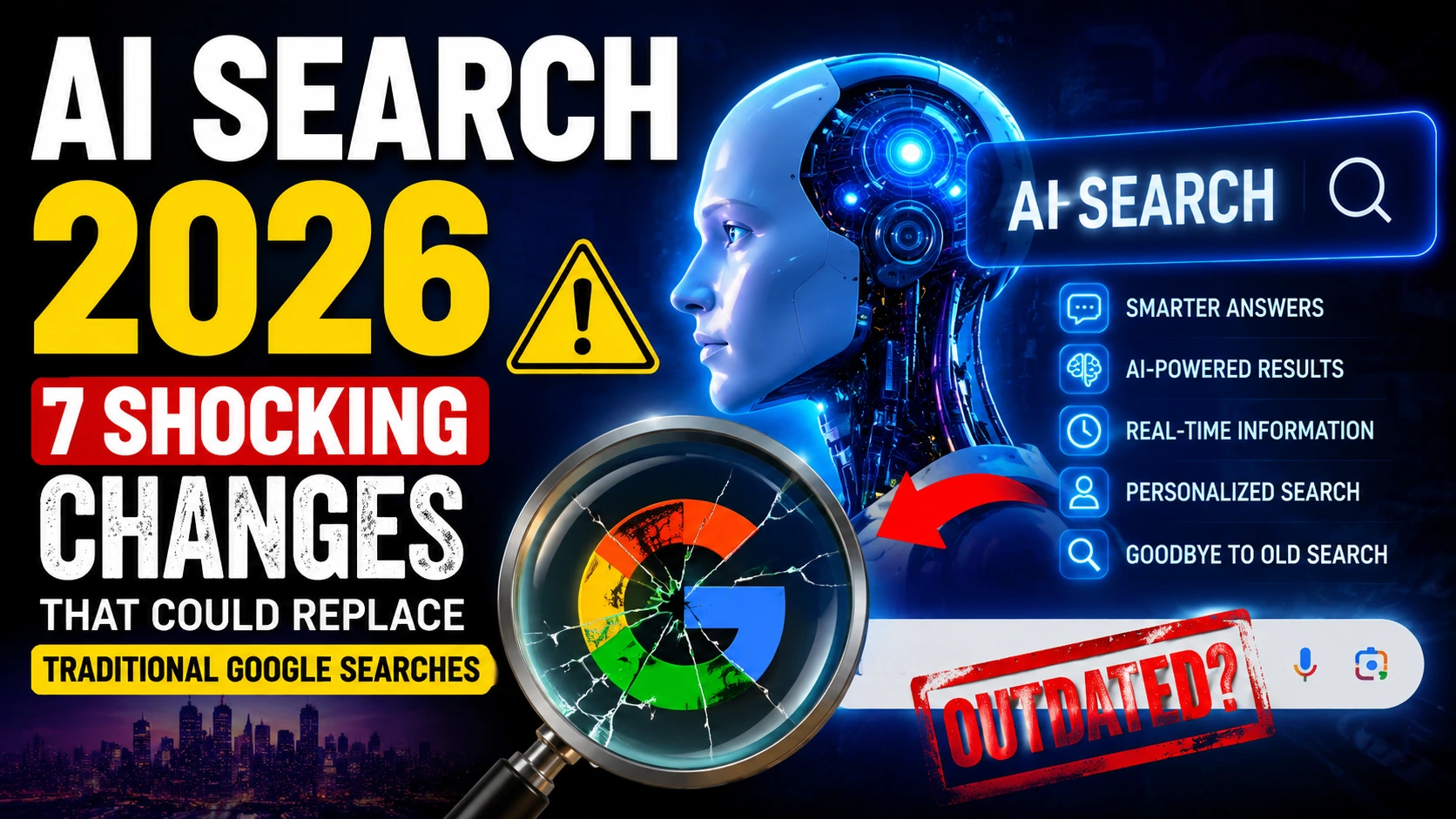
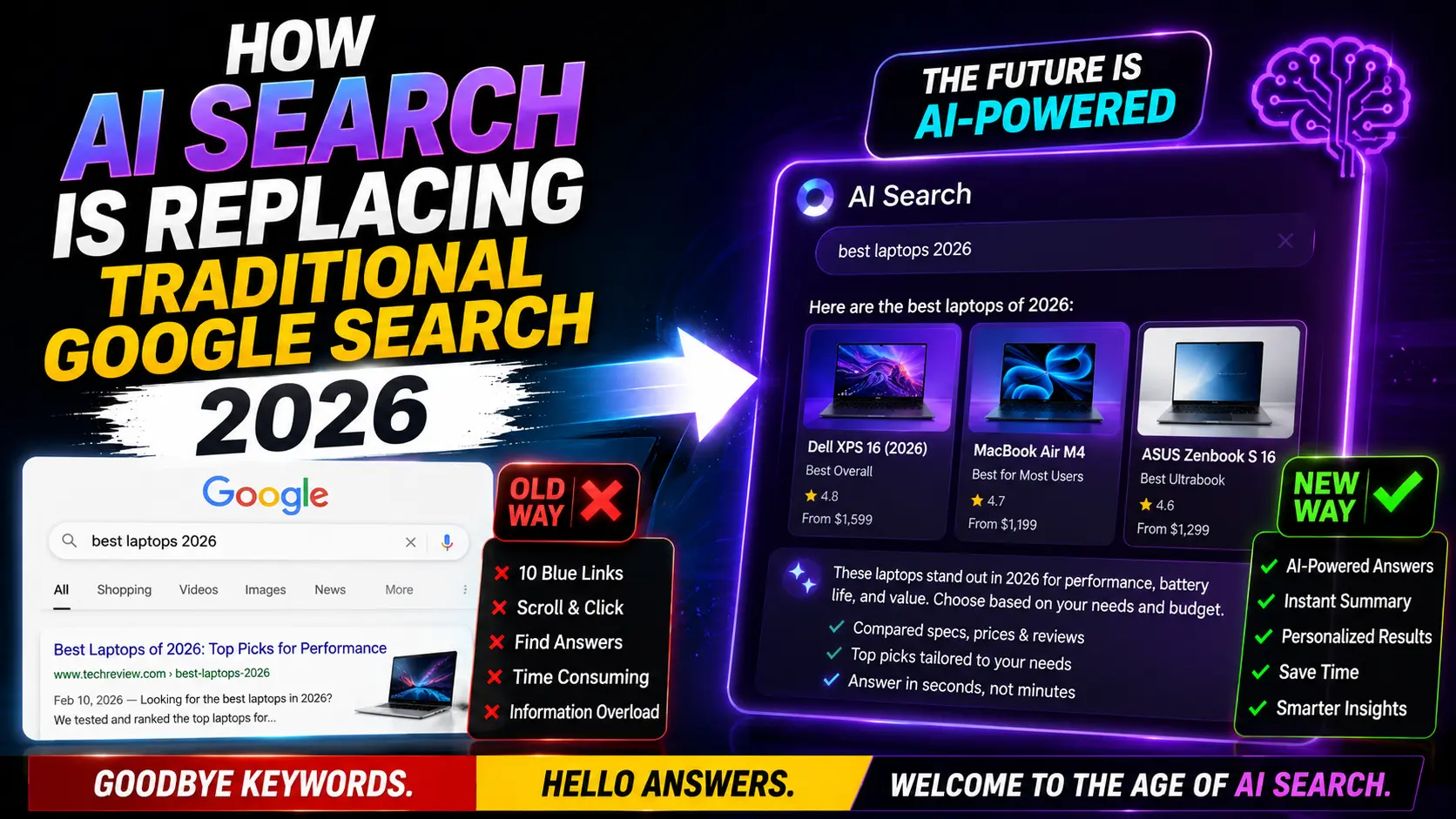
AI Search Replacing Google Search is one of the biggest technology trends of 2026. Instead of showing users a list of links, AI-powered search engines provide direct answers, summaries, and personalized results. This shift is changing how people search online and how websites approach SEO.
If you’ve watched search evolve over decades—from early directories, to PageRank, to mobile-first, to featured snippets—this is the next big shift: the SERP is becoming the destination, and clicks are becoming more selective. [2]
- ChatGPT Search
- Google AI Overviews
- Microsoft Copilot Search
- Perplexity AI Search
Quick Summary (What’s Changing Fast)
- Google is blending classic results with AI Overviews and a more conversational AI Mode that supports follow-ups. [2]
- ChatGPT Search is training users to expect fast answers with source links inside a chat interface. [3]
- Perplexity pushes an “answer engine” model where citations are a first-class feature (often the main reason people trust it). [4]
- Bing/Copilot continues the “generative answers + cited sources” direction. [5]
- The risk: generative engines can still cite wrong or even AI-generated sources, so verification remains critical. [6]
Quick Summary Table
| Platform / Feature | What’s Changing Fast | Ref |
|---|---|---|
| Google (AI Overviews + AI Mode) | Blending classic results with AI summaries + follow-up conversation | [2] |
| ChatGPT Search | Fast answers with source links inside chat | [3] |
| Perplexity | “Answer engine” approach with strong emphasis on citations | [4] |
| Bing / Copilot | Generative answers grounded in web results + references | [5] |
| All generative search | Risk of wrong or synthetic citations → verification needed | [6] |
What “Traditional Google Search” Used to Mean (and Still Does)
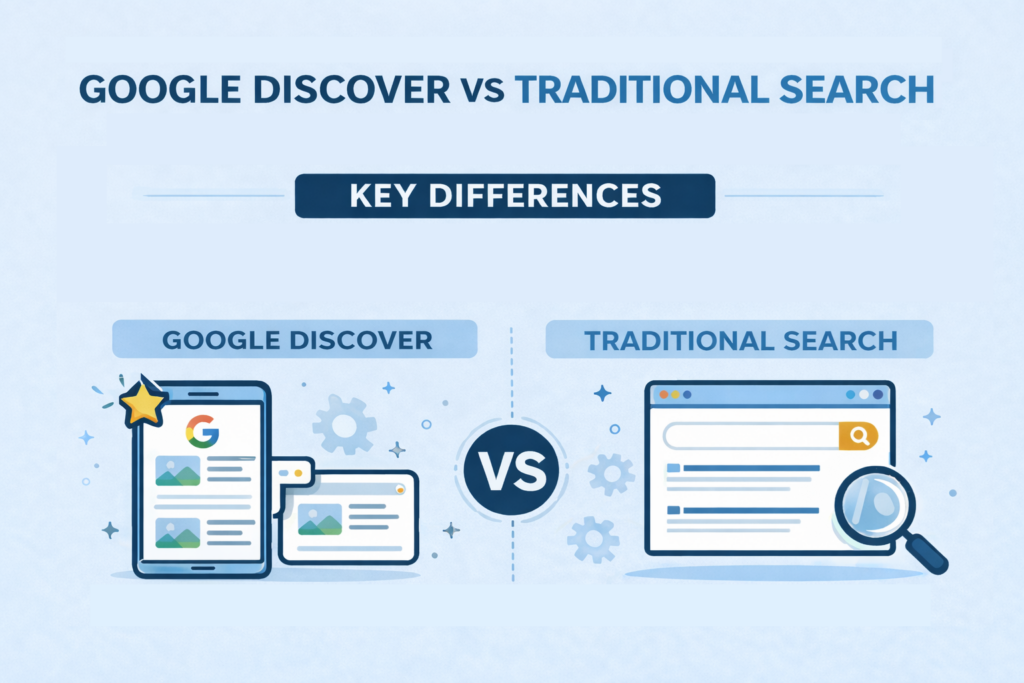
Traditional search is basically:
Query → list of ranked links → you open tabs → you compare → you decide.
That model still exists, but it’s no longer the default experience for many informational queries because the engines now try to give you a ready-to-use synthesis right on the results page. [2]
What “AI Search” Means in 2026 (Plain English)
AI search typically combines two things:
- Retrieval (find relevant pages)
- Generation (write a synthesized answer)
The big difference is that you’re not just getting “the best page.” You’re getting a compiled response (often with citations/links) and you can ask follow-up questions without starting over. [7]
How Google Is Replacing With AI Experiences
1) AI Overviews: the “snapshot answer” layer
Google describes AI Overviews as a way to get a snapshot of key information with links to explore more on the web. [2]
This matters because many users stop after the snapshot if it’s “good enough,” especially on mobile where scrolling and tab-hopping is friction. [2]
2) AI Mode: search that behaves like a conversation
Google’s AI Mode is designed for more complex questions and supports follow-up questions while keeping context—so the search journey turns into a chat flow. [7]
3) More emphasis on “clickable context” (links, previews, subscriptions)
Google has been adding UI improvements meant to make sources easier to inspect—like inline link previews/hover previews and surfacing trusted/subscribed sources in AI experiences. [8]
Bottom line: Google isn’t “dying.” Google is changing form—from a directory of pages into an answer-and-navigation system. [7]
AI Search Outside Google Is Accelerating the Shift
ChatGPT Search: “answers + links” as the default expectation
OpenAI’s help documentation describes ChatGPT search as a way to get timely answers with links to relevant web sources without using a separate search engine interface. [3]
This trains a new habit: people ask longer, messier questions—and expect the assistant to do the stitching.
Perplexity: citations as the product (not a bonus)
Perplexity is widely positioned as an “answer engine” where source citations are prominent and dense compared to typical chat experiences. [4]
That changes publisher competition: you’re not only competing to rank—you’re competing to be selected as a cited source inside an answer.
Bing/Copilot: generative answers with references
Microsoft states that generative AI answers in Bing can include references to source websites so users can verify and learn more. [5]
Why AI Search Is Replacing Traditional Search (The Real Drivers)
1) People don’t want pages—they want decisions
Most searches are not “I want a website.” They’re “I want an outcome”: pick a tool, understand a topic, compare options, get steps. AI answers compress that journey. [7]
2) Follow-up questions are the new “refine search”
Instead of rewording queries 6 times, users stay in a single thread and ask: “Okay, but what if…?” Google explicitly supports this flow from AI Overviews into AI Mode. [9]
3) The web is too big; synthesis is the bottleneck
In traditional search, you did the synthesis across tabs. In AI search, the system does it and (ideally) shows its sources.
The Tradeoff Everyone Misses: Speed vs. Trust
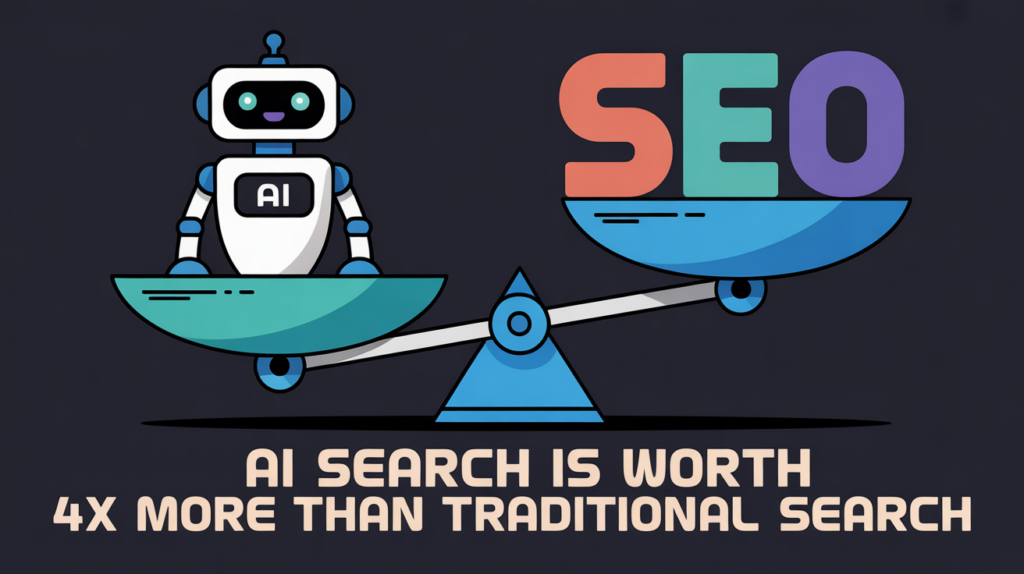
AI answers can be fast and helpful, but they can also be wrong in new ways—especially when they cite sources that are irrelevant, low-quality, or even machine-generated.
A 2026 arXiv audit reported evidence of AI-generated sources being cited across multiple generative search engines they tested (including ChatGPT, Copilot, Gemini, Perplexity). [6]
Practical takeaway: AI search is replacing traditional search for convenience, but verification skills matter more, not less.
What This Means for SEO in 2026 (SEO → GEO)
Traditional SEO asked: “How do I rank?”
AI search adds: “How do I become the cited source inside the answer?”
That’s why you’ll hear terms like Generative Engine Optimization (GEO)—optimizing content so answer engines can extract, trust, and cite it. Research is actively measuring how engines cite and what page factors correlate with citations. [10]
2026 Action Checklist: How to Win Visibility in AI Search (and Google)
Content (what to write)
- Put a direct answer in the first 5–10 lines (then expand).
- Use tight definitions, short steps, and comparison tables (AI engines love extractable structure).
- Add freshness signals (clear “Updated on” date when truly updated).
- Cite reputable sources when you make claims that matter (helps trust with humans and can improve extractability).
Structure (how to format)
- Use one clear H1, then logical H2/H3 sections.
- Use descriptive headings (“How AI Mode Works”, not “Overview”).
- Add a short FAQ section with question-style headings.
Technical (what must be clean)
- Make sure the page is indexable, fast, and readable.
- Use basic structured data if relevant (Article + ItemList for list posts).
CTR + Rank Math 100/100 (Must-Do Rules)
1) Accept Google may rewrite your title/snippet
Google explains how it generates title links and can use prominent headings or other signals if it detects inconsistency. [1]
Google also explains snippet behavior and that your meta description is a suggestion; snippets can be truncated or rewritten. [11]
2) To hit Rank Math 100/100, make sure your keyword appears in:
- SEO title
- Meta description
- URL slug
- First paragraph
- At least one subheading (natural, not spammy)
(That’s the simplest path to pass the plugin’s core checks.)
FAQ
Is AI search replacing Google?
AI search is replacing the old way people use Google (link lists + tab hopping) by adding AI Overviews and AI Mode on top of classic results. Google itself presents AI Overviews as snapshots with links, and AI Mode as a deeper conversational search experience. [2]
Will SEO die?
No— it’s evolving. You still need SEO fundamentals, but you also need “AI citation readiness” (clear answers, strong structure, trustworthy sourcing). [10]
Can I trust AI search answers?
Treat them as a starting point, then verify important claims via the cited sources—because even citations can be wrong or misleading sometimes. [6]
Can I force Google to use my meta title and meta description?
No. Google can generate titles and snippets algorithmically, and it may rewrite them if it thinks other on-page text better matches the query. Your meta title and meta description are best treated as strong suggestions you can influence with clear, accurate writing.
What’s the safest way to use AI search for important topics (health, legal, finance)?
Use AI search to get a quick overview and a list of sources, then confirm details on official or primary sources (government sites, peer-reviewed research, or trusted institutional pages). For personal decisions, rely on qualified professionals, not AI summaries.