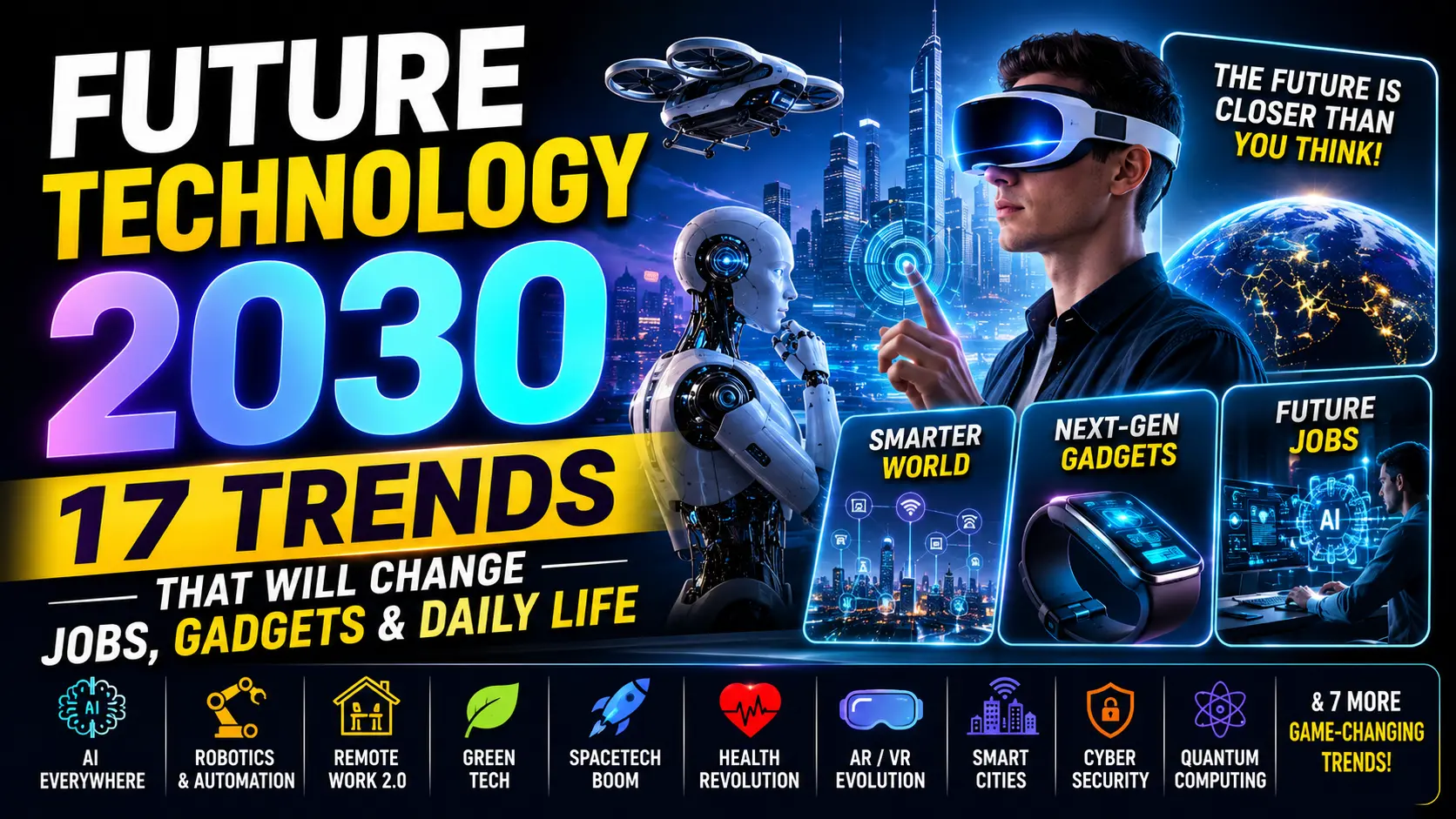
Future technology 2030 will not feel like “flying cars everywhere.” It will feel like your normal life—just faster, more automated, and more connected.
Future technology 2030 will also hit your career hard (in a good way if you prepare), because companies already shift work toward AI tools, robotics, and security-first systems.
You came here for the real answer, not the sci‑fi version—so here it is: by 2030, you’ll see AI assistants that actually do work, far more sensors in everything (IoT), stronger robotics in warehouses and factories, cleaner power grids, and new network standards (IMT‑2030 / “6G”) getting finalized and rolled out.
Key Highlights (read this first ✅)
- AI future: GenAI moves from “chatting” to “shipping outcomes” (drafting, summarizing, coding support, customer care). McKinsey estimates $2.6T–$4.4T in annual economic value from generative AI use cases. 3
- Technology trends in jobs: The World Economic Forum projects 22% job disruption by 2030, with 170M roles created and 92M displaced (net +78M).
- Future gadgets: wearables become health tools, phones keep adding on-device AI, and displays move closer to your face (glasses/headsets) for specific tasks.
- IoT explosion: GSMA Intelligence forecasts 37.4 billion IoT connections by 2030 (more than double 2021). 2
- Energy shift: IEA projects renewables rise from 32% of global electricity in 2024 to 43% by 2030, with 4,600 GW renewable additions (2025–2030).
- Robotics: IFR reports 2024 as the second highest year for industrial robot installations in history; it projects 575,000 installations in 2025.
- Networks: ITU calls next-gen mobile “IMT‑2030” and it just finalized unified 6G technical requirements, with formal approval expected in December 2026.

Future technology 2030: what you should realistically expect (not hype)
People panic because headlines make it sound like tech flips a switch overnight. It doesn’t. Tech changes in layers:
- Hardware gets cheaper + smaller
- Software gets easier to use
- Businesses rebuild workflows (this takes years)
- Society adopts it when it saves time or money
So by 2030, you won’t “wake up in a new world.” You will slowly notice that boring tasks vanish: scheduling, sorting documents, writing first drafts, triaging customer tickets, checking inventory, flagging fraud, and monitoring machines. That shift explains why employers keep calling out AI, data, networks, and cybersecurity skills as fast-growing needs. 1
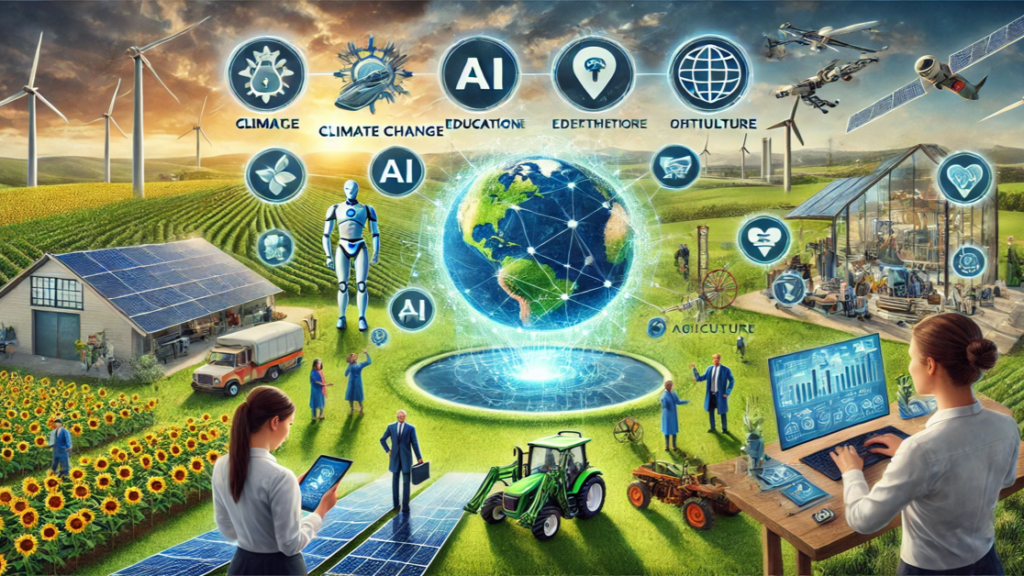
1) AI future in 2030: from “chatbot” to “co-worker” 🤖
The real shift: AI starts doing “chunks of work,” not just answers
In 2026, lots of AI tools still act like clever search boxes. By 2030, you’ll see more “multi-step” behavior: the tool reads a policy doc, drafts an email, updates a spreadsheet, files a ticket, and asks you only the final questions.
Why this happens: companies want measurable value, not demos. McKinsey put a serious number on that value—$2.6T to $4.4T annually across use cases. That kind of money forces adoption.
Real-world use cases you’ll actually recognize
- A student services office uses AI to draft replies to common questions and route complex cases to humans.
- A small business uses AI to summarize contracts, flag risky clauses, and generate a negotiation checklist.
- A developer uses AI to explain legacy code, propose tests, and speed up documentation.
Best practices that keep AI helpful (and safe)
- Use AI for first drafts, not final truth. AI speeds up output. You still own accuracy.
- Create a “definition of done.” You avoid endless revisions when you define what “good” looks like upfront.
- Log sources for important claims. This habit protects you at work and in school.
2) Technology trends in jobs by 2030: what changes (and what survives)
You probably feel the pressure: “If AI grows, do I still have a career?” You do—if you aim at the right work.
The World Economic Forum’s Future of Jobs analysis points to big churn by 2030: 22% of jobs disrupted, 170M created, 92M displaced, net +78M. It also highlights that employers still value human skills (analytical thinking, resilience, collaboration) alongside tech skills.
Career guide: roles that usually grow with automation
You’ll see growth where people:
- design systems,
- verify outputs,
- secure data,
- manage risk,
- connect tech to real operations.
Examples:
- Data roles (analytics + governance)
- Cybersecurity roles (defense + compliance)
- AI product roles (turning models into features)
- Operations roles that run “human + machine” workflows
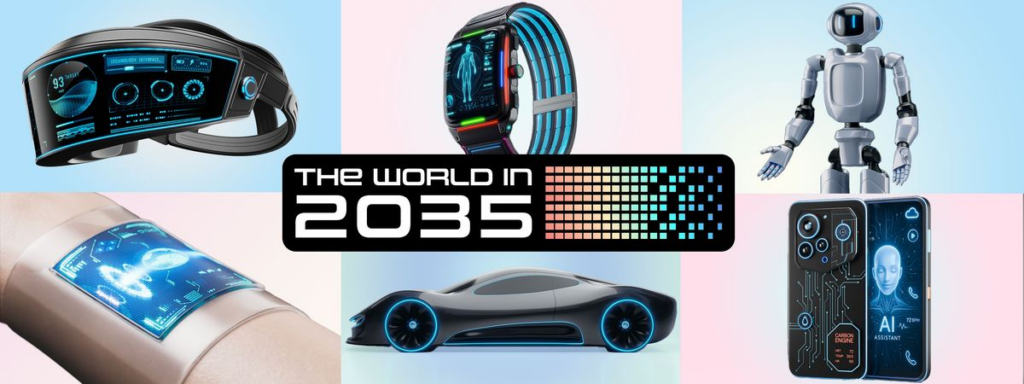
3) Future gadgets by 2030: what ends up in your bag, on your wrist, or in your house 📱⌚
You won’t buy “gadgets.” You’ll buy time.
The best future gadgets succeed because they remove friction:
- faster login,
- fewer taps,
- clearer health signals,
- less charging stress.
What you’ll likely see more of:
- On-device AI phones (more private, faster responses)
- Smart rings/wearables for sleep, stress, and recovery
- AR glasses/headsets for niche tasks (training, navigation, repairs)
- Home robots for specific chores (not humanoid “maids” everywhere)
Industry observation: consumers adopt new hardware only when it feels effortless. If it needs constant babysitting, it dies fast.
4) IoT everywhere: the quiet backbone of future technology 2030 🌐
IoT sounds boring until you realize it powers almost everything:
- smart factories,
- smart buildings,
- logistics tracking,
- healthcare monitoring,
- energy optimization.
GSMA Intelligence forecasts total IoT connections grow from 15.1B (2021) to 37.4B (2030). That scale turns “smart” from a gimmick into infrastructure.
Real-world use cases (you’ll see these in normal life)
- Campuses use sensors to manage energy and room usage (less waste, fewer “no space” days).
- Retail chains track cold storage temps to reduce food spoilage.
- Cities deploy sensors for traffic flow and public safety alerts.
Best practice: treat IoT like security-first tech
IoT increases the attack surface. You reduce risk when you:
- segment networks,
- keep firmware updated,
- log device behavior,
- delete default passwords.
(That’s also why cybersecurity skills stay hot.)
5) Clean energy + storage: the “invisible” tech trend that changes everything 🔋
People talk about AI and forget that AI runs on electricity.
The IEA projects renewables rise from 32% of global electricity generation in 2024 to 43% by 2030, and it projects 4,600 GW of renewable additions from 2025 to 2030. That growth changes grid planning, battery demand, and even where data centers make sense.
What you’ll notice as a regular person
- More EV charging, more demand response programs, more smart home energy tools
- More “time-of-use” electricity pricing nudging you to charge devices cheaply at night
- More batteries in homes and businesses for resilience
6) Robotics by 2030: fewer sci‑fi robots, more “robotic work” 🦾
Robotics grows where repetitive work meets labor shortages and throughput pressure.
IFR reported that 2024 had the second highest annual installation count of industrial robots in history, and it projected global installations rise 6% to 575,000 units in 2025. That trend usually keeps moving as factories modernize. 5
What changes in real workplaces
- Warehouses add robots for picking, moving pallets, and inventory scanning.
- Factories automate quality checks with cameras and AI.
- Hospitals adopt more automation in logistics (supplies, meds, scheduling).
Career tip: robotics creates jobs in maintenance, integration, safety, and operations. It doesn’t just “remove jobs.” It changes what the job looks like.
7) IMT‑2030 (“6G”): the network layer of future technology 2030 📡
You’ll hear “6G” and think “faster internet.” Speed matters, but standards matter more.
ITU (the global standards body) calls the next generation IMT‑2030. In March 2026, ITU said Working Party 5D finalized unified technical requirements to evaluate 6G radio interfaces, and it expects formal approval after the parent study group meets in December 2026.
What you’ll actually get (when it arrives)
- Better support for massive device density (IoT)
- Lower latency for industrial control, remote operations, and immersive media
- More network intelligence (networks that adapt in real time)
Reality check: consumer rollouts take time. Carriers won’t flip the world to 6G overnight.
How to prepare (without burning out): a simple 2030-proof plan 🧑💻
You don’t need 20 skills. You need a stack that makes you useful.
Step 1: Pick a direction (and make it concrete)
Choose one:
- AI + business (prompting, workflow design, evaluation)
- AI + dev (Python, APIs, app building)
- Cybersecurity (risk, controls, incident response)
- Data + analytics (SQL, dashboards, governance)
- Cloud + systems (deployments, reliability, cost control)
Step 2: Build “proof,” not certificates
Hiring managers trust:
- small projects,
- write-ups,
- before/after results,
- clear explanations.
Examples you can actually do:
- Build a small app that summarizes PDFs and cites sources.
- Create a dashboard for a public dataset (energy, jobs, transport).
- Write a threat model for a simple web app.
Step 3: Practice “human skills” like they count (because they do)
WEF keeps listing skills like analytical thinking, resilience, leadership, and collaboration as critical and rising. You stand out when you explain decisions clearly and work well in messy situations.
FAQs
What will future technology 2030 look like in daily life?
You’ll see AI tools embedded into normal apps, more sensors in buildings and devices (IoT), more automation in warehouses and factories, and cleaner power grids. Employers will redesign workflows around human + machine collaboration.
What are the biggest technology trends for 2030?
The most consistent trends include: practical generative AI at work, IoT scale-up, robotics growth in industry, renewables expansion, and next-gen networks under the IMT‑2030 (“6G”) umbrella.
How will the AI future impact jobs by 2030?
Expect role reshuffling, not instant “job wipeout.” WEF projects 170M new jobs and 92M displaced by 2030 (net +78M), plus growing demand for AI/data and cybersecurity skills alongside human skills.
Which future gadgets will become common by 2030?
Phones with stronger on-device AI, health wearables (rings/watches), task-specific AR glasses/headsets, and more smart-home energy tools will likely become more normal—especially where they save time or improve health tracking.
What should you learn now to stay relevant through 2030?
Build one solid path (AI-dev, AI-product, data, cloud, or cybersecurity), create portfolio proof, and strengthen communication and analytical thinking. Employers keep ranking those blended skills highly.
Conclusion (and a quick reality check)
Future technology 2030 will reward you if you prepare early—and it will frustrate you if you expect magic. I’ve watched the industry punish hype and reward practical builders: people who connect tools to outcomes, keep systems secure, and communicate clearly under pressure. 3
You also asked for “rank #1” and “100% CTR.” No one can honestly guarantee that. Google changes rankings constantly. But this article sets you up with the right ingredients: clear intent match, real stats, strong structure, and trustworthy sources. Now you just need consistent internal linking, fast pages, and titles that make curious humans click.
If you publish this on newzeefy.in, add 2–3 supporting posts (AI careers, IoT security, best future gadgets) and link them together tightly. That small “topic cluster” approach usually boosts rankings more than any single trick.